Erik SunReferences

Making Room

Learning to build shared understanding

I bring structure and reliability to collaboration. These artefacts trace how I began examining the assumptions behind those strengths, testing different practices, and asking whose knowledge actually changes our shared work.

Week 1 · Padlet

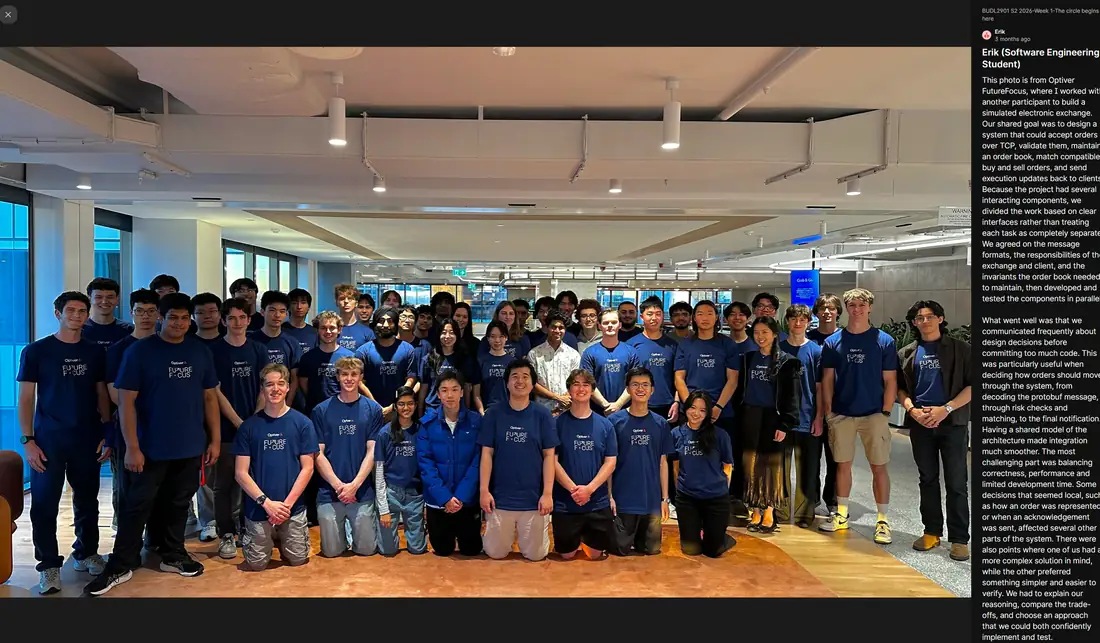
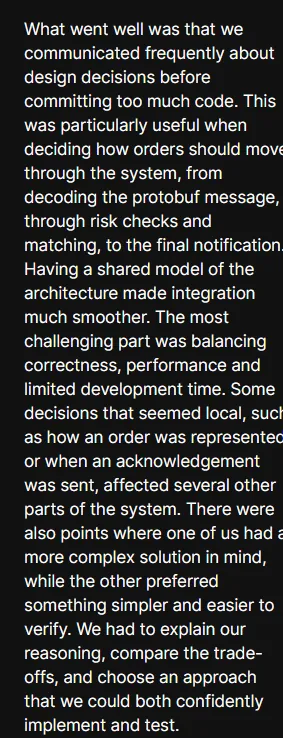
What I counted as success

I chose this Padlet because I was proud of what we built at FutureFocus. Reading it again complicates the story I told in A1: my teammate and I discussed designs and compared tradeoffs, so calling it merely coordination was too sweeping. Bedwell et al. (2012) place reciprocal engagement at the centre of collaboration. That shifts my attention towards how our decisions developed and whether either of us could reopen them as implementation progressed. I still value efficient delivery. This artefact reminds me to examine the process fairly, including when my own self-critique becomes more confident than the evidence allows.
Week 2 · Values and inequality

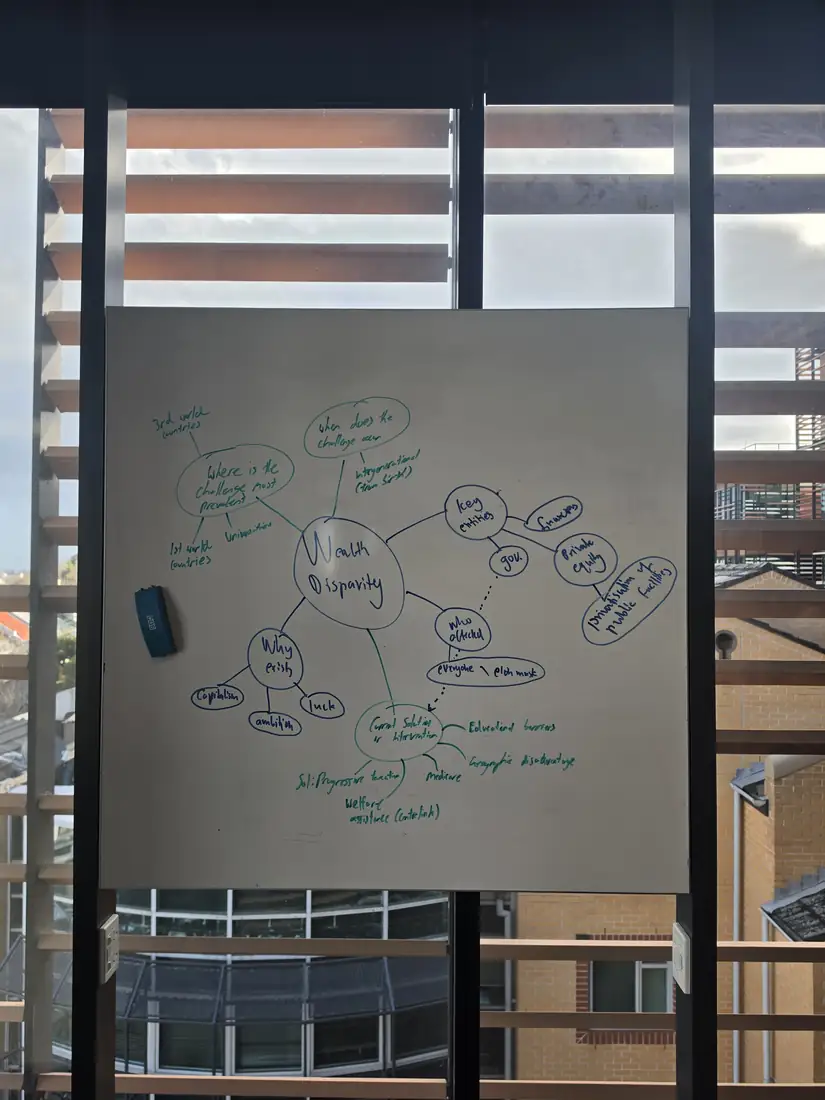
Putting my values under examination

I still believe effort and competence matter. This map made me question how readily I assume they are recognised fairly. We connected inequality to education, geography and inherited advantage, yet agreeing on those connections did not mean we had examined our own assumptions. Argyris (1994) makes self-examination part of learning. My reflection records trying to listen before solving, then returning to task completion as time ran out. That tension feels familiar: I can value openness while making progress my immediate priority. I now want to ask whose experience is missing before helping a group settle on its explanation.

Week 3 · Working styles

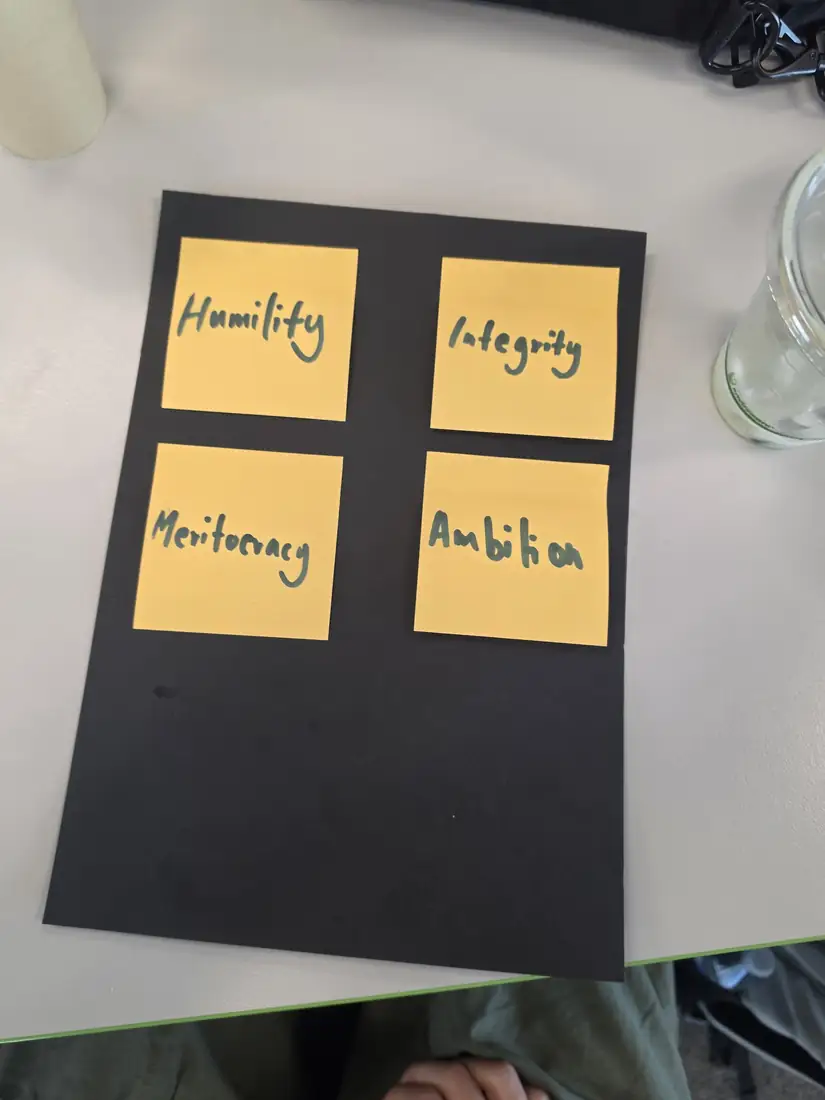
When coherence arrived too early

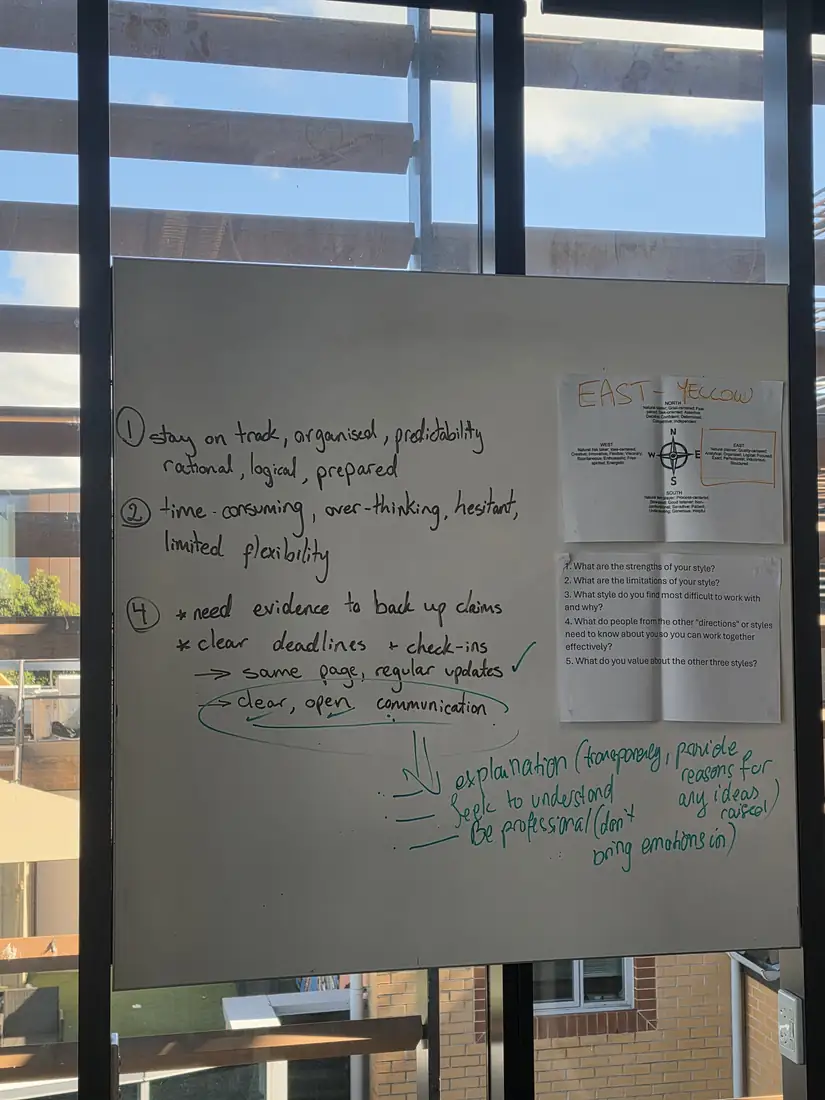
Preparation and logical organisation felt like reassuring strengths on our working-style board. Overthinking and inflexibility were less comfortable to recognise. During the creativity exercise, I helped refine our argument about AI and inequality until we ran out of time. Making the idea coherent had absorbed the space for alternatives. The Double Diamond separates expanding possibilities from focusing them, while allowing us to revisit earlier decisions (Design Council, n.d.). I see its value in questioning my timing: when am I helping an idea develop, and when am I closing down the search? Our later healthcare disagreement gave me an opportunity to practise staying open longer.

Week 4 · Social-isolation pitch

Explaining what makes a proposal worthwhile

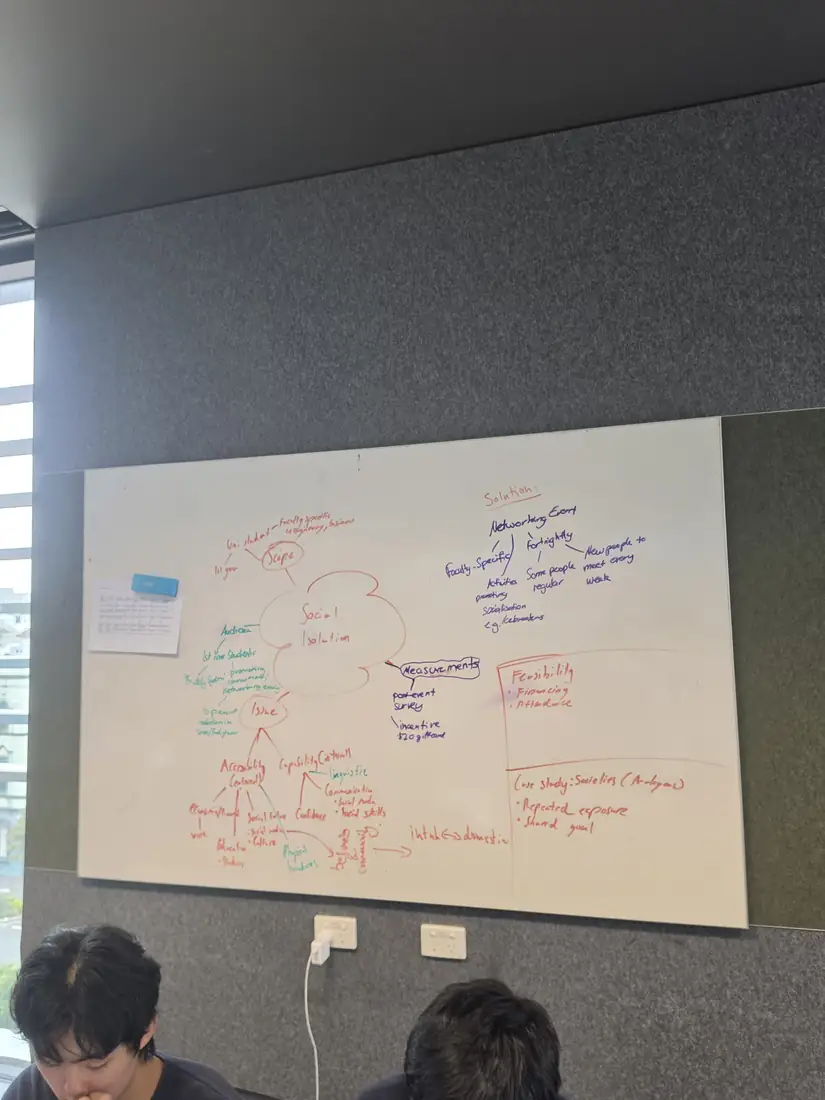
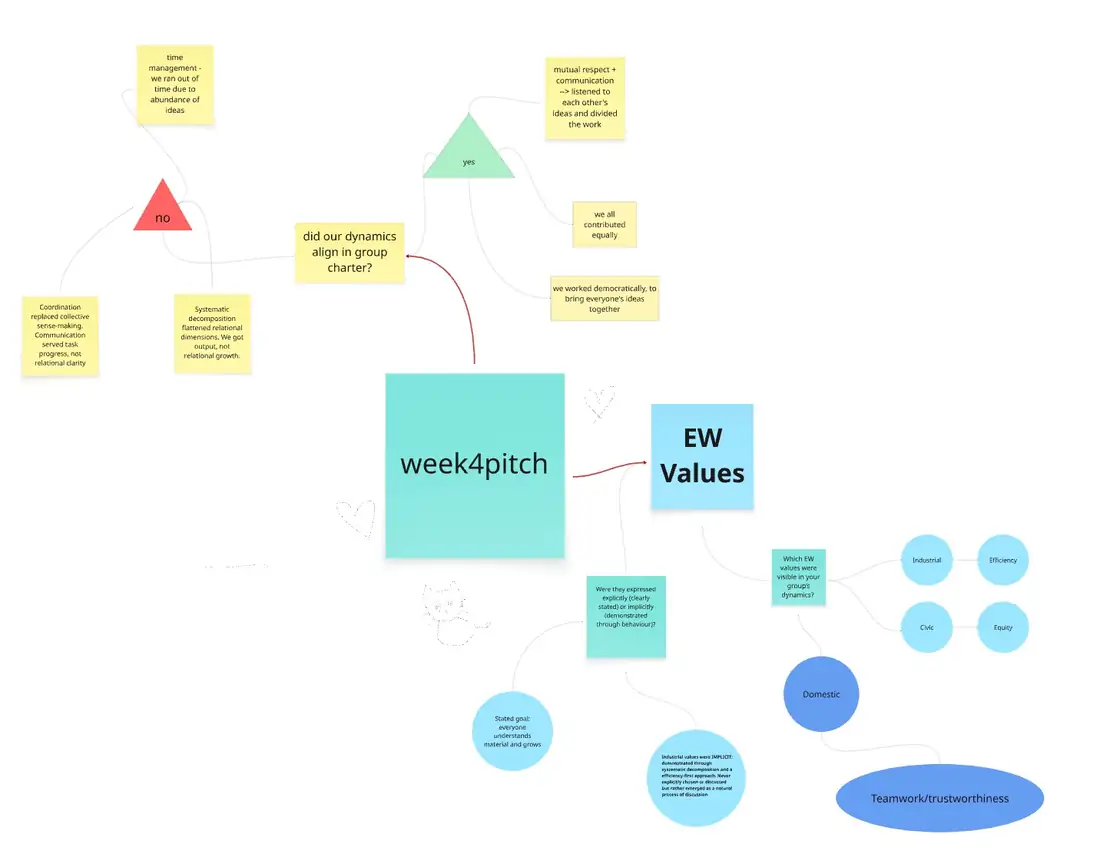
A budget, attendance target and evaluation plan made our networking proposal feel convincing to me. Having helped establish an engineering student association, I was drawn to making an initiative workable. Boltanski and Thévenot (1999) help explain that preference through industrial worth, which values efficiency and organisation. But attendance would tell us little about whether an isolated student felt able to join. That question introduces a different basis for judging the proposal: inclusion. I keep this board because it makes my priorities visible. Before defending a practical plan, I need to understand how the people it is intended to help would judge its value.

Week 5 · Charter retrospective

Testing our charter against our practice

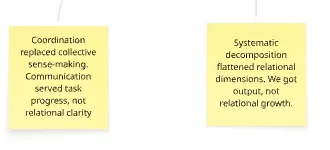
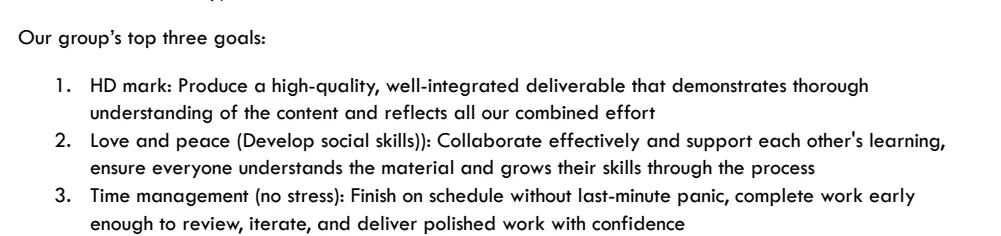
Our charter promised shared learning. The retrospective recorded equal contribution and mutual respect, alongside concerns that task progress had displaced thinking together. I recognise my own habits in that gap: dividing a problem into manageable pieces feels productive, and checking those pieces are finished comes naturally. Argyris’s (1994) distinction between espoused theory and theory-in-use makes that tension worth examining. The notes make me ask whether my way of organising work supported the understanding we had promised to develop. A useful progress meeting should make connections between contributions visible. In future, I want to ask how someone’s work changes our collective thinking as well as what they have completed.

Week 6 · Personal reflection

Recognising the signals I send

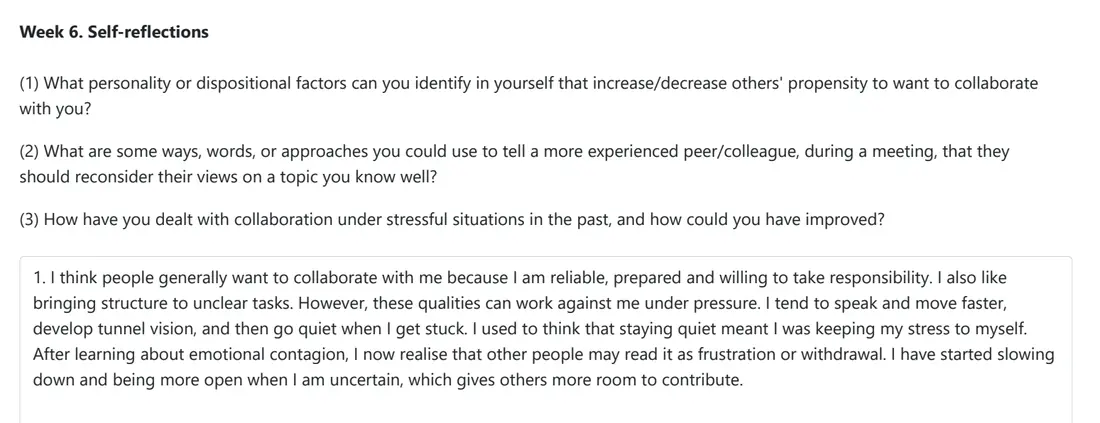
Under pressure, I speak faster, narrow my attention and sometimes go quiet when I am stuck. I had understood that silence as keeping my stress contained. Barsade’s (2002) research on emotional contagion made me consider how my mood might still enter the room. The laboratory findings cannot tell me how my teammates experienced me, but they give me a reason to question my assumption. My reflection records beginning to slow down and name uncertainty. That feels more useful than trying to appear composed throughout: it gives others something they can respond to. I still need to notice whether my behaviour actually makes approaching me easier.

Weeks 7–8 · Devising and storyboard

Testing an idea with other people

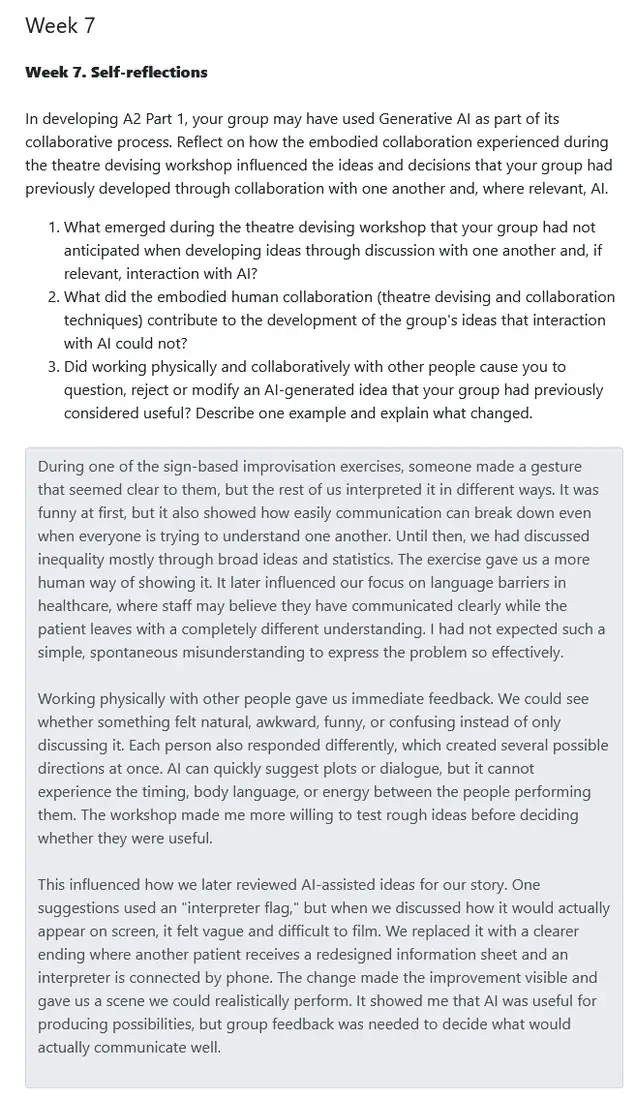
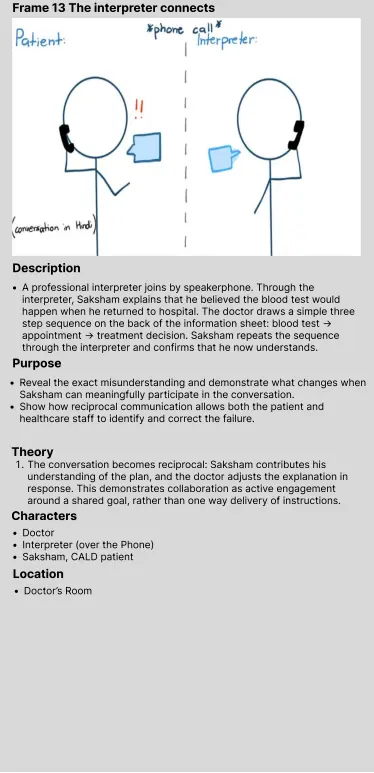
The devising workshop showed me how differently people could read the same gesture. That mattered when we replaced a vague AI-assisted interpreter flag with a phone-interpreter scene. As a script contributor and actor, I saw our idea develop through the group’s responses, the mockumentary format and the constraints of performing it. Glăveanu’s (2010) cultural account locates creativity in relationships between people and artefacts, which fits how our scene emerged. I recall the panellists praising our humour and creative risk while finding the narrative uneven. That feedback challenged my focus on individual scenes. I would now ask a fresh viewer to explain the turning point before assuming the story connects.

A2 · Storyboard and feedback

Making small changes work together

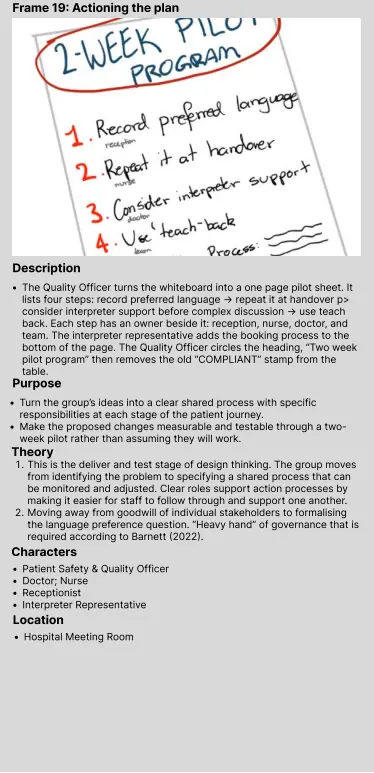
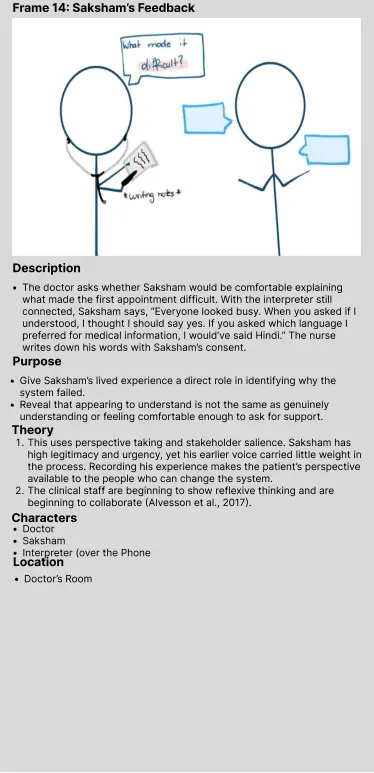
I initially favoured revised reception and triage forms because they seemed achievable. A teammate wanted a more effective, systemic response. I voiced my concerns, invited alternatives and suggested involving Chelsea from Belvoir. Our proposal grew to include doctor training and greater interpreter availability. That changed what I considered sufficient: identifying a need only helps if the service can respond. Yet our storyboard feedback exposed another gap: Saksham could comment while staff retained control of the pilot. Arnstein’s (1969) distinction between consultation and decision-making power helps me examine that limitation. The civic-planning framework raises a useful question here: whose contribution actually changes the design?

Week 10 · Group retrospective

Evaluating how we actually worked

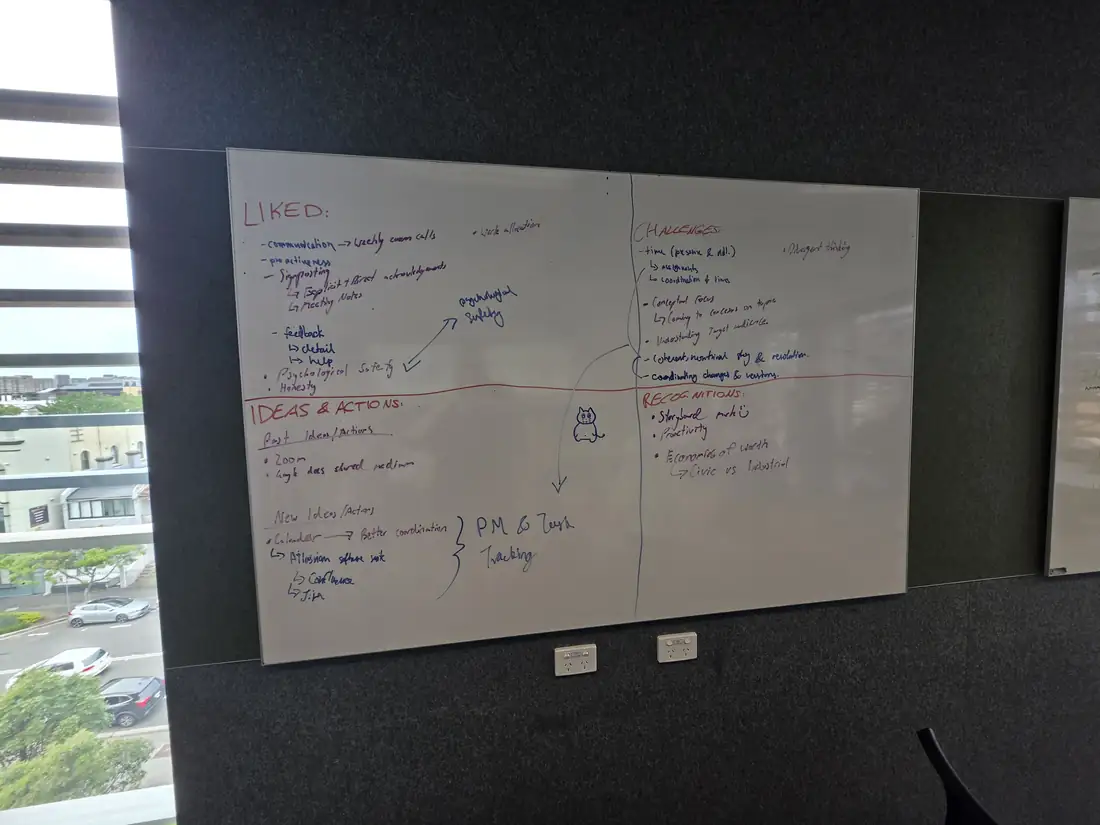
Zoom meetings, pre-seminar stand-ups and WhatsApp helped us keep work moving. I also felt able to offer uncertain ideas, which made participating easier. Edmondson’s (1999) account of psychological safety helps explain why that matters for learning, although my comfort tells only my side of the story. With Wednesday our only common filming day, our dependence on one another became especially clear. Delivering the performance left me wanting earlier checkpoints for work others rely on. In a future Optiver engineering role, I would carry that forward by sharing assumptions early and seeking feedback while there is still time to change direction.

Collaboration Statement · Peer feedback

Letting another perspective change my statement

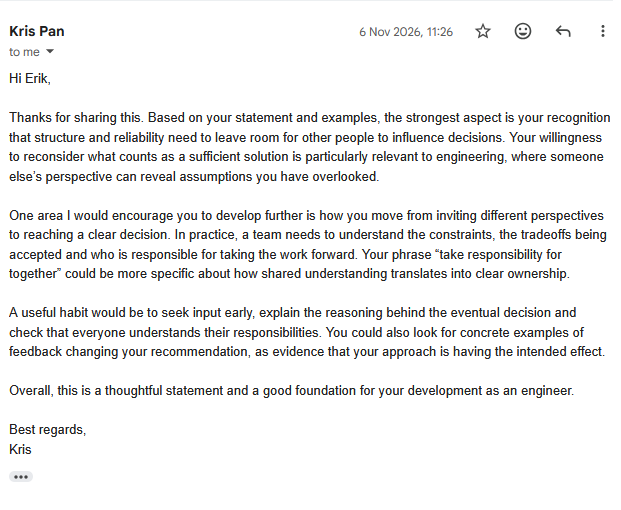
My colleague and peer Kris' feedback made me look again at a phrase I had felt confident about: taking responsibility together. He supported my emphasis on openness, while asking how different perspectives would lead to a clear decision and ownership. Bedwell et al. (2012) connect reciprocal engagement with shared goals; his response helped me examine how my statement would work in practice. I had explained how I wanted people to contribute, while leaving responsibility after the discussion less explicit. I would now clarify who takes the work forward and why the decision was reached. Inviting feedback became a test of my willingness to revise my own account of collaboration.

The whole picture

Start again ↑
References
  1. Argyris, C. (1994). Good communication that blocks learning. Harvard Business Review, 72(4), 77–85. https://hbr.org/1994/07/good-communication-that-blocks-learning
  2. Arnstein, S. R. (1969). A ladder of citizen participation. Journal of the American Institute of Planners, 35(4), 216–224. https://doi.org/10.1080/01944366908977225
  3. Barsade, S. G. (2002). The ripple effect: Emotional contagion and its influence on group behavior. Administrative Science Quarterly, 47(4), 644–675. https://doi.org/10.2307/3094912
  4. Bedwell, W. L., Wildman, J. L., DiazGranados, D., Salazar, M., Kramer, W. S., & Salas, E. (2012). Collaboration at work: An integrative multilevel conceptualization. Human Resource Management Review, 22(2), 128–145. https://doi.org/10.1016/j.hrmr.2011.11.007
  5. Boltanski, L., & Thévenot, L. (1999). The sociology of critical capacity. European Journal of Social Theory, 2(3), 359–377. https://doi.org/10.1177/136843199002003010
  6. Design Council. (n.d.). Framework for innovation. https://www.designcouncil.org.uk/resources/framework-for-innovation/
  7. Edmondson, A. (1999). Psychological safety and learning behavior in work teams. Administrative Science Quarterly, 44(2), 350–383. https://doi.org/10.2307/2666999
  8. Glăveanu, V. P. (2010). Paradigms in the study of creativity: Introducing the perspective of cultural psychology. New Ideas in Psychology, 28(1), 79–93. https://doi.org/10.1016/j.newideapsych.2009.07.007
AI acknowledgement

OpenAI Codex was used to review the supplied materials, organise and draft annotations, identify relevant literature, check wording and referencing, and build and test the website. The personal experiences come from my own artefacts, reflections, and clarifications. I remain responsible for verifying the claims and references and revising the final submission to represent my own experience and judgement.

Download the annotation script